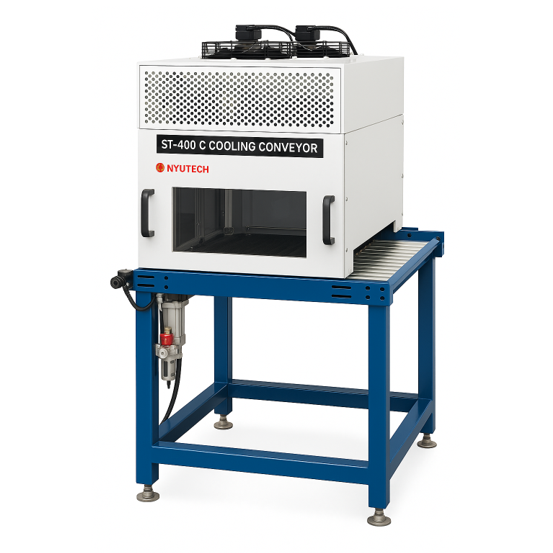
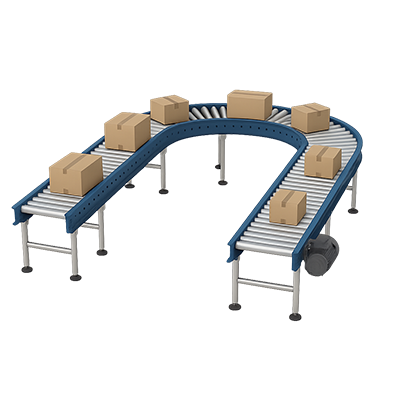
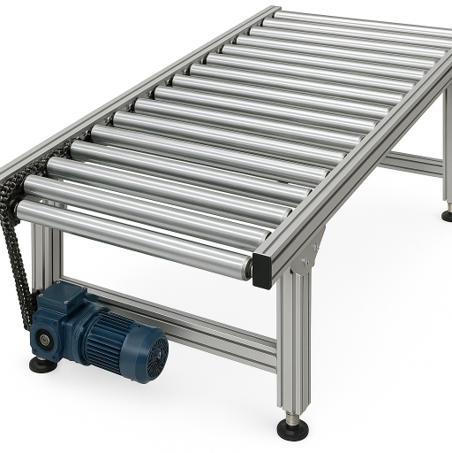
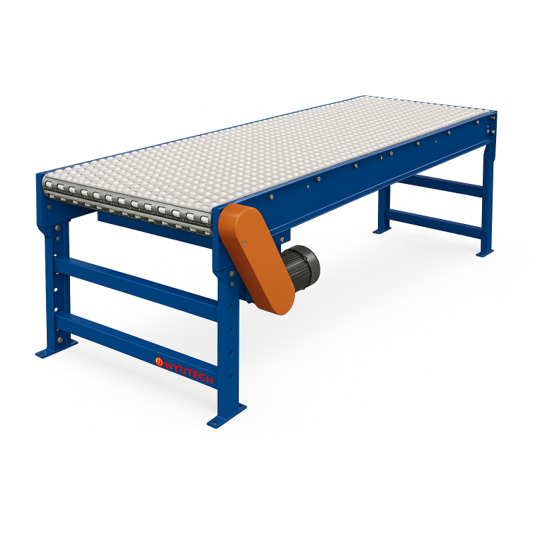
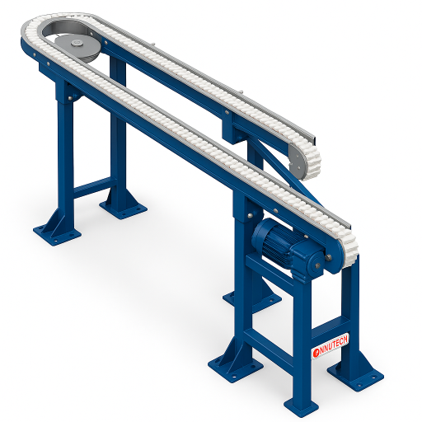
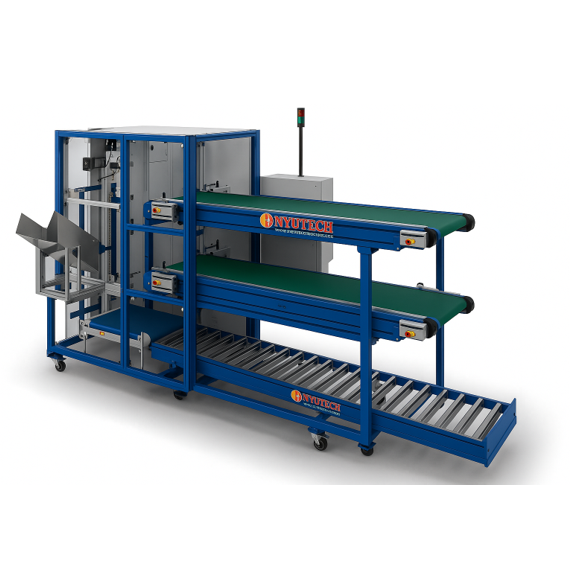
A roller conveyor is a material handling system comprising aligned cylindrical rollers that support and transport items. The items roll over the rollers either by gravity, manual push, or by powered drive. Roller conveyors are fundamental in automated assembly, inspection, packaging, and distribution lines, serving as reliable linkages between workstations.
System Architecture & Types
Gravity Roller Conveyor
- Non-powered rollers; items move by force of gravity or manual push.
- Simple, low-cost solution for accumulation, staging, or buffering.
- Typically used in inclined or declined layouts.
Powered / Motorized Roller Conveyor
- Rollers driven by motors, belts, or chains.
- Allows controlled speed and direction even on flat layout.
- Supports inline, continuous transport for heavier loads.
Line-Shaft Driven Rollers
- A single drive shaft under the conveyor connects to rollers via belts or “O-bands.”
- Good for modular systems where power supply to each roller is impractical.
Independently Driven Rollers (MDR)
- Each roller has its own motor (e.g. 24 V DC).
- Offers flexibility and zone-based control.
Special Variants
- Curved Roller Conveyor: curved layout for direction change.
- Accumulation Roller Conveyor: supports zero-pressure accumulation zones
- Expandable / Telescopic Roller Conveyor: extendable length for loading/unloading.
Design Parameters & Important Specifications
Roller Diameter & Material
- Choose appropriate diameters (25 to 89 mm or more) depending on load and product shape. Use stainless steel, carbon steel, or coated rollers based on environment.
Roller Pitch (Spacing)
- Rollers closer together support small items better. Typical pitch is around half or two-thirds of the shortest side of the item.
Frame & Structure
- Rigid profiles (steel, aluminum) with modular design, height adjustability, leveling feet.
Drive & Motorization
- Chain drive, belt drive, or individual motor per roller. Use overrunning clutches or backstops to prevent reverse movement.
Speed & Control
- Variable speed via VFDs or servo drives. Integration of sensors (photoelectric, proximity) for control and jams.
Loading & Support
- Load capacity per roller, total load, number of rollers under heavy loads.
Safety & Standards
- Side guards, emergency stops, pinch-point protection, compliance to ISO 13857, EN 619 safety standards, IEC 60204, etc.
Key Features & Benefits
Simplicity & Reliability
- Low maintenance, straightforward mechanical design.
High Throughput
- Power-driven versions enable fast, consistent transport.
Flexibility
- Modular and extendable designs ease reconfiguration.
Integration Ready
- Compatible with PLCs, MES systems, sensors, interlocks.
Space Efficiency
- Compact layouts for tight factory floors using curves or accumulation zones.
Energy Efficiency
- Certain designs support regenerative braking or zone-wise power-off when idle.
Application Areas
- Automotive and EV assembly lines
- Inspection and testing module transfers
- Packaging, sorting, and distribution systems